


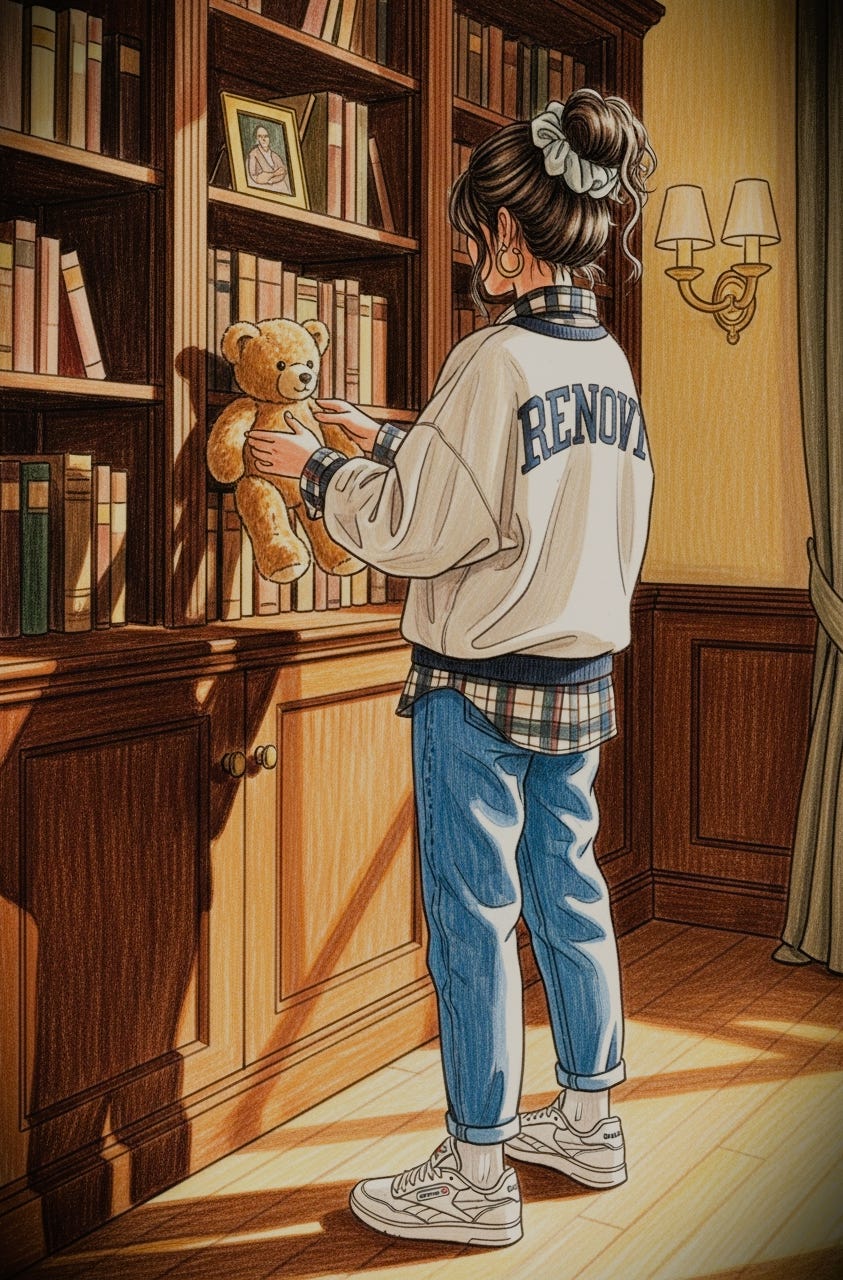
Juliet opened her eyes in the bright room. She had forgotten to draw the curtains, and the sunbeams woke her. Something terrible was connected to her brother. Something far worse than she wanted to admit. As if the strict, dispassionate voice of a doctor or a teacher were speaking inside her head: ‘Lewd acts against a young child.’
It sounds vile.
Criminal definitions are always about someone else—but not this time.
This time, she is that child.
What about her brother? Is he still in prison?
Juliet jumped up, unable to stay calm. No, no, no! Why had she been taken to Bradford, to the damned museum? Why had she begun to look at those photos? Why was all this thrust upon her? Oh—now she understood why she had not remembered her childhood. She was afraid of memories. Forgetting was her defense. After yesterday, there was no way back.
No matter how much she wanted it, she could not return to ignorance.
From now on, she must go all the way—she has to untangle it.
“Get it together and put a smile on your face!” Juliet instructed her reflection in the mirror as she washed, combed her hair, and packed her bag.
To call Derek?
She was by no means dying to see him. But they had arrived together, and leaving without him would look too strange. Could she come up with an excuse? Urgent business. Someone sick. Died? She dialed the number, not knowing what she would say, “Derek... Yes, good morning. Did you sleep? No? Are you lying to me? You sound sleepy.” God knows how much effort it took Juliet to pretend to be carefree. “Well, if you’re already up, when are you coming? I’m waiting for you.” Unable to think of a convincing excuse, she killed her one chance to slip away on the sly.
She paced from corner to corner, then stopped at the window. Time dragged unbearably. When the knock finally came at the door, Juliet tried to compose her face into something ordinary, everyday.
With a broad smile, Derek once again wished her good morning, took her bag, and kissed her on the cheek. “How did you sleep? Did your headache go away?”
“What?”
“Yesterday you said you had a headache. You wanted to go to bed early...”
“Yes, yes, it’s gone.”
“You’re not coming down with something, are you?”
“Everything is fine.”
“Then what shall we do? Let’s go to Leeds right away…” Derek started talking about plans that no longer meant anything.
Juliet stopped listening. She had often been angry at Derek for not bothering to ask questions and for the way he avoided confrontations—whether out of selfishness or timidity. Now she silently thanked him for the chatter and the laughing eyes.
She could not tell him—not now, maybe not ever.
Juliet remained quiet while they had breakfast in the hotel restaurant, waiting for him to finish his coffee before saying, “We’re going back to London.”
“How come? Why so suddenly?”
“Not suddenly. Forgive me, I should have told you. I didn’t know yesterday. I need to go home. My father and I have arranged to meet,” Juliet lied. “I was thinking maybe we could leave tomorrow, but it’s better if we go today.”
“Wow! That’s a turn-up.”
In the car, Derek cranked the music full blast and said nothing for the rest of the drive, letting Juliet drift into her own thoughts. Knowing him, he put her mood down to a woman’s whim—as changeable and unjustified as the weather—and for that, Juliet was grateful as well.
Finally, he delivered her safely and walked her to the porch.
“All right, moody girl. Bye.” He squeezed her hand. “We’re good, aren’t we?”
“Yeah.” Juliet brushed a quick kiss past his lips. “We’re fine.”
She promised to call, climbed the stairs, turned to wave, and forgot about him the moment the front door closed behind her.
Alone, with the sense that her life was spiraling into hell and everything had turned upside down, Juliet went straight to her father’s study. What to look for? She stopped in the middle of the room. If there were documents, they would be in the bureau drawers. Juliet took a step toward the heavy desk—and then caught sight of something odd. Had it always been there, on the bookshelf? She approached, slid back the glass door, and lifted out a teddy bear. Her father had kept her old toy—the last trace of her early childhood. Did it ever have a name? None came to mind. Once, this bear had meant a lot to Juliet. Her favorite toy. She remembered no others—because none had been bought for her. Why would her father keep a shabby bear? She remembered: he had dug it out of the trash, clambering over boxes in his expensive suit. Someone had tossed it away like rubbish. The bear was already worn then. What joy it had been when her father pulled it free and said, “Your bear will just need a wash.” Jerry had been the one who bought it. He brought it wrapped in paper. She had torn the wrapper apart, too impatient to untie the string, and inside was a toy too big for her small hands. Her brother knelt before her. Juliet had thrown her arms around his neck, laughing.
Jerry… Brother… A criminal?
Somewhere here, her father must have kept things more important than old toys.
With the bear tucked under her arm, Juliet went to the drawers of her father’s desk. The ones on the left were all locked, but the top drawer on the right gave way—and she suddenly found herself face-to-face with her brother.
She recoiled.
For a while, she only stared at the photograph lying on a pile of papers, unwilling to pick it up and take it out. In the black-and-white picture, Jerry was shockingly young. A frail teenager, almost still a child himself, hugging his little sister of four or five against the backdrop of grass and trees. A park! A sunny day they spent together. Juliet had been happy then. Happy? The photo showed no shadow on her face, only bright serenity. And her brother’s face—so familiar. She hadn’t thought of him in years, yet she would have recognized him among a thousand others. With eyes like those, he could never have committed a crime, much less harmed his five-year-old sister.
She leaned closer to the photograph: where had she gotten that idea? Did she imagine villains carried warnings written across their foreheads? She looked like a carefree child, and he a kind boy. But appearances deceive. She had not understood what was being done to her. Or perhaps he had loved her, in his own way? A wild, terrible thought. The longer she looked, the more she felt something was wrong with her brother. His smile touched only his lips, not his eyes, making the expression look unnatural. Why did he matter so much to her? She could not remember her real mother or father. Only him. Why had she lived with her brother?


