


Juliet took the photograph and set it on the table, placed the bear beside her, and picked up the phone. She had to find Jerry and question him about everything. Let him deny it, let him lie—she would see through him, she would understand the truth the moment she confronted him.
“Hi, Dad. I’m home… Don’t worry… What do you mean by ‘I came to my senses’?” It was a rhetorical remark. “Dad, I’m calling for a reason. You do know where my brother is, don’t you?”
Usually she had to interrupt him, now there was silence on the other end of the line, as if they were disconnected.
“Dad! Are you there? I want to see him. I have the right! Why aren’t you answering? Dad! Give me Jerry’s address!”
“Juliet, dear, we can’t talk about this over the phone,” her father said in a strange, hoarse voice; there might have been interference on the line.
“Is it so hard to tell me where he lives?” Juliet had to shout.
“We’ll speak when I get there.”
“I don’t want to wait! You’re not being fair! I need to know who I am!”
He was silent again.
“Don’t you understand?” she asked.
“I understand. Juliet... All right, your documents are in the safe, and the code is one, seven, nine, one.”
“Is everything there?”
“Everything is there.”
“And his phone number? Address?”
“Do you really want it? Maybe we should talk first?”
She hesitated. He was reasonable, as always. To face her brother… oh God… she was still in the absolute darkness about what had happened when she was a child.
“Got it, Dad.”
“Juliet, take your time.”
“Yes,” she replied, though she was in a hurry. “Bye!”
One, seven, nine, one—these were the digits of her birth year in reverse, ah, Dad… She had been too harsh with him, suspecting he would rather not stir up the past.
Opening the safe, Juliet was taken aback by the sheer number of papers. Yet the folder containing a copy of her real birth certificate turned up surprisingly quickly.
Miranda Smith and Oliver Smith— she read her parents’ names.
Is this some kind of joke? With a name like that, she could vanish into anonymity.
Her birthplace, Sutton-in-Ashfield, she’d have to look it up on a map.
The folder also contained further documents from the adoption agency. She learned about some ‘special circumstances’ that had allowed Alexander Landenberger to become a single father of an adopted girl, and Juliet knew there was no blood tie. His fortune and connections must have played a decisive role. In a copy of the London County Council’s ruling, both her parents were listed as deceased.
As for the brother—no trace. Just in case, Juliet rummaged through the rest of the papers, with no real expectation.
Several documents, an old toy, and a photograph. Precious little. The search ahead would be long; she would need patience and would have to start small—probably in Sutton-in-Ashfield. The guidebook placed it in western Nottinghamshire. North again. As if it were fate. Juliet had a feeling that Jerry would not be there. She could find only memories that belonged to others; she herself recalled nothing of that northern town.
Juliet checked the forecast for Sutton-in-Ashfield: highs of twenty-two, with sunny spells and the chance of showers later on. A typical August day. She would have set off straightaway, despite only just returning, but decided to be sensible. The drive was at least three hours, perhaps longer. She needed a meal and some rest first.
Night brought regret, when the same thoughts refused to leave her, making it impossible to focus on anything else. Juliet turned on the TV, flipped through channels for several minutes, and then shut it off. She tried to read, but the words lost their meaning and slipped away from her. She put down the book and sat clutching the teddy bear—just Bear—gazing at her brother’s impenetrable face.
For some reason, Juliet felt that the photo her father kept in his desk wasn’t of her with Jerry, but of Jerry with her. Why remind himself of her brother’s face? Was he still thinking of what had happened fifteen years ago? Why hadn’t he given her a phone number? Didn’t he know where Jerry was? And she, a fool and a coward—both at once—had not insisted.
Juliet could not sleep, drifting from feverish heat to chills. All she longed for was the quick arrival of dawn. On the verge of wakefulness, her father had to protect her from her brother, but she, instead, sided with her brother against him, accusing her father—
Guilty of what? Everything was the other way around!
As soon as the sky outside the window began to pale, she jumped out of bed. Breakfast was nothing more than a cup of coffee and a slice of cheese.
The bear would stay at home. The documents and photograph were coming with her.
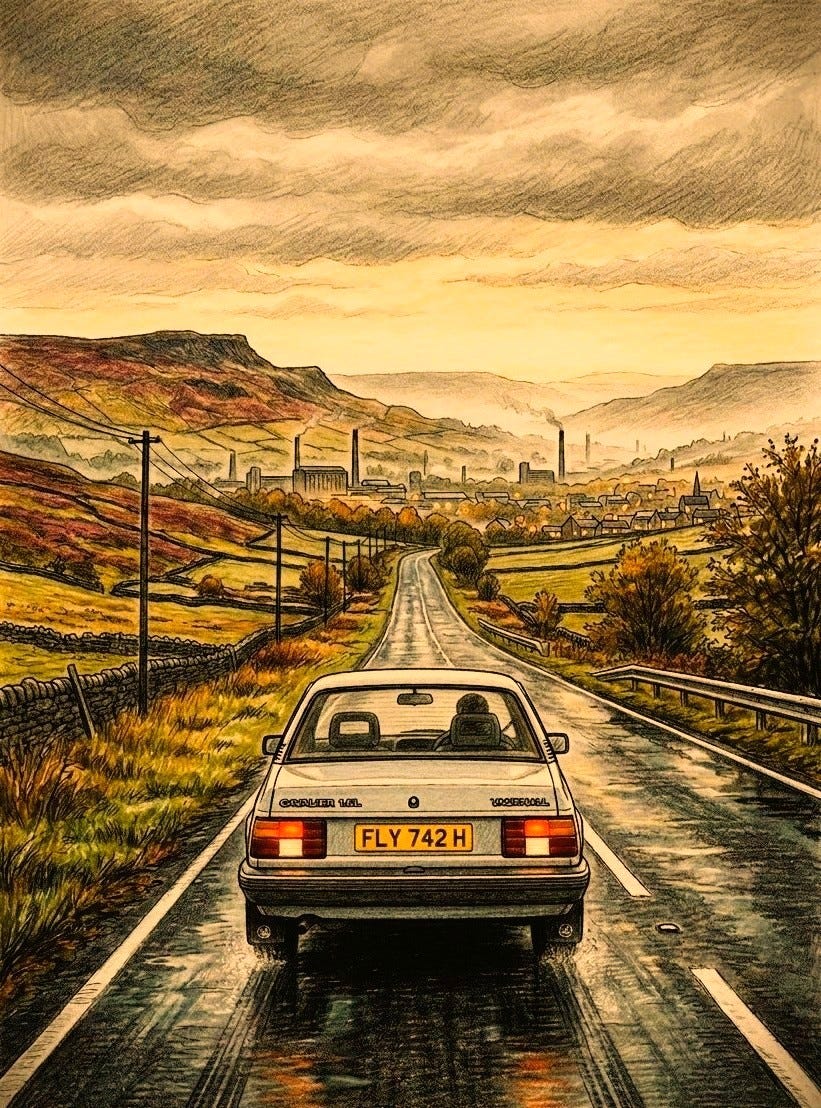
Pulling out of the garage in her dull light-gray Vauxhall Cavalier, Juliet thought briefly of Derek—then pushed him aside. She did not need him. Not now. This was her life, her burden, and she had to face it on her own.
On the way to Sutton-in-Ashfield, Juliet got anxious. Everything was happening too quickly, and she felt unprepared—to hear too much, to face people who might know more about her than she did. Halfway there, she nearly turned back. What stopped Juliet was the sheer absurdity of doing so with the best part of the journey already behind her.
Her next panic attack began as she arrived in what the documents listed as her birthplace. Nothing looked familiar—just another tired northern town, houses and streets indistinguishable from those of the neighboring small towns, and a stubbornly gray sky, despite the forecasters’ promises of partial sunshine. It seemed the sky here was always gray.
Juliet knew she ought to ask for help, but the locals appeared unfriendly.
Driving through the town center, she noticed the police station and decided to try her luck there.
The duty officer greeted her with the studied politeness which felt ill-suited to the modest surroundings. He listened with patience and a kind of weary sympathy as Juliet stumbled through her story: that she had been born here, her parents had died, she had been taken to London and adopted, and she had no memory of any of it. How much he actually grasped from her tangled account was hard to tell; she was constantly interrupted, with other policemen coming over, repeating questions, clarifying details. In the end, a small knot of curious listeners had gathered around, their voices marked by a sharp northern accent. The general advice was that she should go to the registry office in nearby Mansfield. But Juliet was not after marriage records or certificates. She had not come for paperwork. She wanted to know where she had lived—and, if luck allowed, to speak with someone who had once known her parents.
“Neighbors?” the policewoman asked, skeptically. “It’s been almost twenty years since your father’s death… You said he was a miner?”
“I didn’t say so, but I believe he was.”
“And the pit closed three years ago…”
“So what? Places like Sutton don’t change much,” a stout gentleman in plain clothes cut in.
“Did your father happen to die down the pit?” the duty officer asked.
“Yes!” Juliet reacted as if struck by an electric current, in a sudden flash, she saw her mother crying in the kitchen. It felt like a memory from the very edge of childhood. Why didn’t she remember before? “In the pit!”
“Then you should try the miners’ club,” the little gathering decided, almost as one.
The duty officer rang up, and it turned out to be a great idea. A certain Mr. Ketcher worked there and said she could come round. He would wait for her at the club.
Mr. Ketcher knew and remembered Oliver Smith.


