


Juliet felt a bitter emptiness.
Pot fêlé dure longtemps.
Her brother used to say it.
And now—fifteen years later—she discovered she could still repeat that phrase word for word.
Even a cracked pot could last forever.
How many French sayings had she once learned from him? Most were gone. Gone? What about Ne jamais dire jamais?
Never say never.
That was why she shunned anything French. She never studied the language, never listened to French songs, never even set foot in France—for one reason only: not to remember her brother. “Sorry. What did you say?”
The teacher had to ask again. “How is Jeremy now? What’s he doing?”
Juliet gave the same prepared reply as before. “I was adopted. I don’t know where my brother is. I’m trying to find him. Sorry to trouble you.”
“It’s I who should apologize, Miss Smith. I’m afraid I can’t help. I haven’t heard a word about your brother since the day he left our school. Someone once said he’d gone to London. I wouldn’t have been surprised if he’d gone abroad.”
Juliet found herself asking, almost to her own surprise, “Was he ever bullied? Teased?”
“As far as I know, there was nothing like that—not in our school.” the teacher replied. “Though clever children often aren’t liked. But your brother…” He hesitated. “I’ll tell you something a teacher really shouldn’t. It may sound harsh, but even at an age when most young people are just being nihilistic, Jeremy—bright as he was—seemed to lack any real moral compass.”
Juliet stiffened again. “What do you mean?”
“Well… Jerry wrote other pupils’ papers—for money. The boys joked about it, called it ‘working together,’ and sang the phrase to the tune of Happy Together. It was an open secret though never proven. Had the school tried to punish everyone involved, dozens of pupils would have been implicated. There would’ve been questions from parents, governors, perhaps even the LEA. In the end, the headmaster preferred not to see too much.”
Juliet exhaled with a mixture of reassurance, admiration, and dread. No wonder the school had been relieved to be rid of him. By fifteen, Jerry had made everyone around him complicit in his lies.
The teacher lingered as they said goodbye, but Juliet was barely listening to him.
Her feelings seemed extinguished, leaving a single refrain: tired. The word pulsed in her mind, as if she were noting a fact about someone else.
“Are you unwell?” Juliet heard the words dimly, through the veil of an all-consuming sensation: how tired she was, how very tired.
“What hotel are you staying at?”
The practical question forced Juliet to pull herself together. She had not considered how long she might remain in Sutton-in-Ashfield. Now she was faced with the necessity of finding a bed for the night.
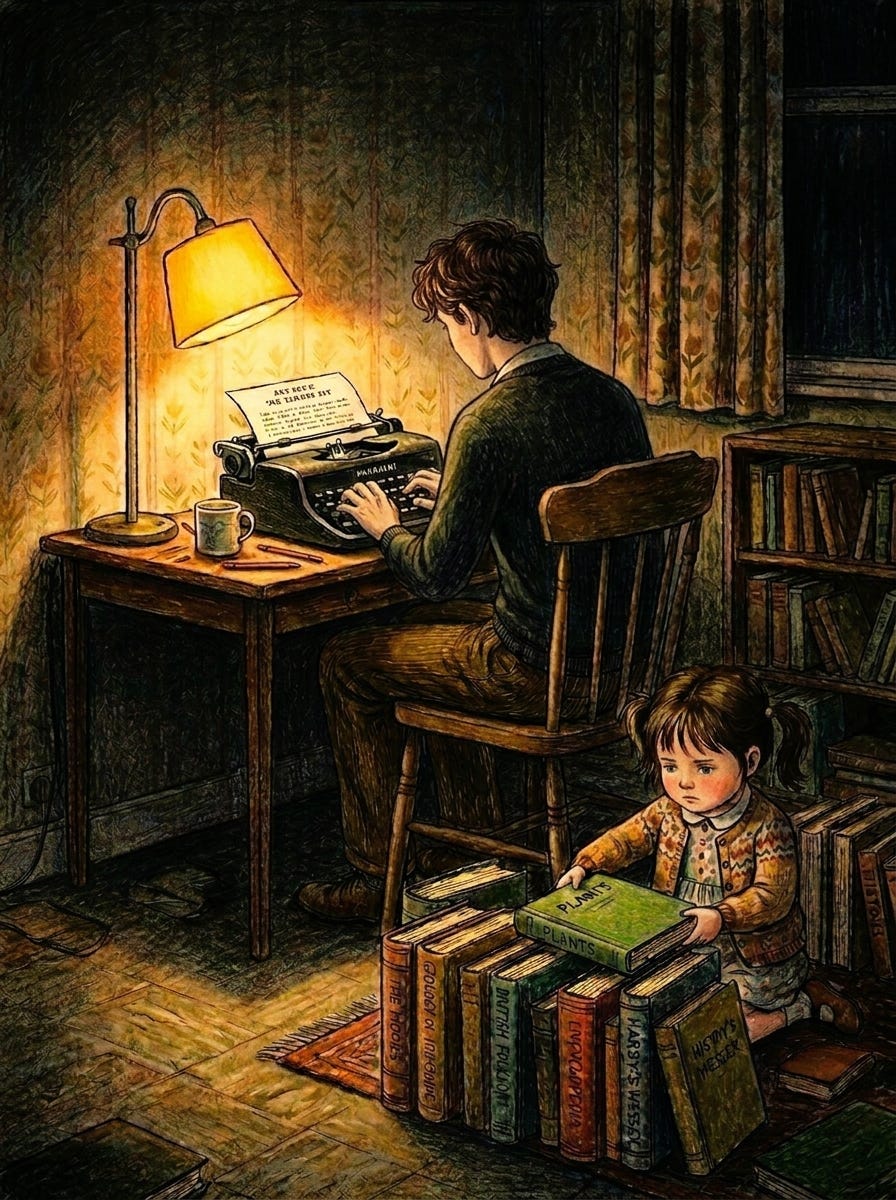
As she drove on, Juliet almost burst into tears. Tiredness, she told herself. Nervous tension. It had been years since she’d had to talk to strangers like this, for day on end—let alone asked them for help. As it turned out, only pitiful fragments came back to her: dead father, alcoholic mother, and a star-pupil brother who broke the rules. Flashes, blurred like out-of-focus photographs. The old teacher had told her so little about her brother, and yet it felt like so much. The memory of the book pyramid surfaced suddenly, bringing a dull ache to her chest. She had once built a castle out of thick adult volumes, listening to the furious clatter of the typewriter. No wonder her brother had never been caught writing essays for others: he typed them on a machine, not by hand. And it wasn’t even his own typewriter.
Juliet pulled into the first hotel she saw and accepted the room without a second thought. Though her body was drained, she knew sleep wouldn’t come, and solitude would do her no good. She wandered down to the hall, a space that doubled as both bar and dining room.
A few heavy drinkers nursed their pints at the tables—clearly the sort of regulars who could put off any passing guest, if there were any to scare away.
Juliet ordered a meal, leaving the choice entirely to the barman who also served as waiter.
What’s a girl like she doing in a place like this?
The despondent drunkards paid no attention to her. People with nothing—no work, no prospects—were slowly pickling themselves in alcohol.
Her mother had belonged to it once. She cried complaining about the widow’s fate. Sometimes there’d be a bottle and a glass in front of her. Sometimes just the bottle. She drank straight from the bottle, wiping her mouth and drunken tears with the back of her hand, until Juliet’s brother came home from school and took away their mother’s drinks. They yelled at each other. Jerry grabbed Juliet in his arms and carried her out of the kitchen slamming the door behind him. Their mother shrieked, “Well, bugger off, you devilish offspring! You are so callous! You’re not my son! You can’t be mine!”
Was this scene a memory, or only an image stitched together from all she had heard that day?
Juliet pushed the bland food around on her plate, examining the peas to see if they were edible—or best avoided—when a sharp reek of liquor washed over her.
“Good evening, lady.”
A shabby little man loomed beside her and swayed on unsteady feet.
“What do you want?” Juliet asked with deliberate rudeness.
“A million apologies! I don’t mean to intrude, but for the life of me, you remind me of someone. Let me think...”
“Why don’t you go back to your table to think?”
The little man nodded and stepped aside—though not toward his own seat. Instead, he flopped into the chair across from Juliet.
“I’ve got a memory like an elephant’s,” he assured her, rubbing his chin and fixing her with the bleary stare of a drunk.
Juliet was about to call the waiter-bartender to be rescued from his unwanted company when the man slapped his palm against the table.
“Got it! You look like Randie! Blast it—Miranda Smith!”
Juliet shuddered as if someone had taken a swing at her. Her mother’s name had been flung onto the table like a greasy playing card. This degraded little man knew Miranda Smith. He called her Randie. Miranda Smith had known him. So this was what her mother had been—reeking, slurring her words, eyes rimmed with red. Like this man, she could barely control her own hands and struggled to gather her thoughts. Juliet flushed with shame for her mother, lowered her gaze, and laced her fingers in her lap, fighting back the disgust.
The drunkard drifted into his own memories.
“Randie, Randie,” he muttered. “I haven’t thought of you in a long while, Randie. Poor girl.” It wasn’t clear whether he meant Juliet or her late mother. “A pity... And you look like your brother, too, lady.”
It hit Juliet all at once—her brother could come back here to drink himself to death, the simplest of endings. “Do you remember him well?”
“Of course,” the drunkard grunted with smug assurance. “I remember everything—even the things I’d rather forget. Now then, if you’d be so kind, lady, as to buy me a drink, wet my throat a bit, I might tell you something worth hearing.”


