


A small, plump woman with a pleasant face addressed her.
Juliet nodded.
“Let’s go and have some tea with us.”
“Oh, thanks for the invitation. I don’t want to burden you...”
“Don’t be silly! Come on, let’s go!” the woman said, smiling self-consciously, as if she were afraid of being seen with such an expression.
Juliet couldn’t help but smile back.
“Much better!” the woman approved. “You drove the car here, didn’t you? Quite a distance, I take it?”
Juliet guessed the woman wanted to know where she had come. “Yes. All the way from London.”
“Are you tired?”
“A little.”
“My tea will restore your strength. Harry—my husband—claims nobody makes tea like I do, though I wouldn’t swear to it—ah, there he is!”
Plump and resembling his wife so closely he might have been her twin brother, Harry flung open the front door in a gentlemanly way and made a playful bow. “Ladies.”
“Thank you, sir,” Juliet half-curtsied.
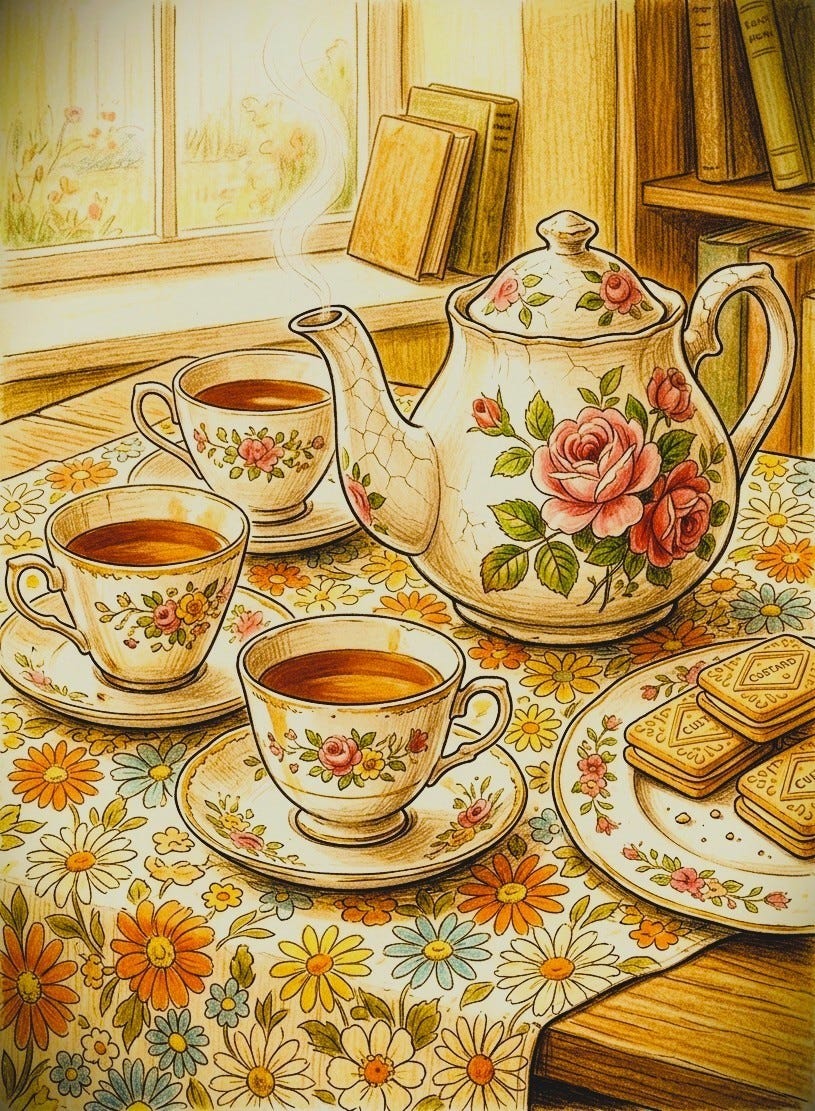
The living room she was invited into suited its owners perfectly: old-fashioned floral wallpaper, porcelain shepherds and shepherdesses wherever there was space, and brightly colored furniture. Juliet was seated on an orange sofa.
“Keep our guest company. Excuse me, I’ll be right back. Oh, cabbage head—we forgot to introduce ourselves! Call me Aunt Polly, and my husband, Uncle Harry!” With that, “Aunt” hurried to the kitchen, from which the sounds of the radio drifted.
“Do you remember my parents?” Juliet asked, though she feared being too direct. “Your wife just asked me if I was from the Smith family.”
“Not so much.” Uncle Harry glanced out the window, then around the room, as if seeking support or approval from the things surrounding him. “I’d be glad to help, my dear, on my word. They didn’t trouble us. We didn’t trouble them. As they say, live and let live.”
Aunt Polly returned from the kitchen carrying a bowl of biscuits and a floral porcelain sugar basin. “How are you here without me?” she asked, then bustled back again.
“And my brother, Jeremy Smith? Don’t you remember him?”
“He was a good boy,” Uncle Harry nodded, confirming his own words. “Polite, you know what I mean—always said good morning. I dislike ill-mannered people, can’t stand them. Jeremy Smith once sat right where you are now, honey.”
Juliet almost jumped.
Aunt Polly appeared with a milk jug in one hand, three saucers with a cup balanced on top in the other, and vanished again without a word.
“Your brother...” Uncle Harry went on, and Juliet’s heart sank at those two words.
“Once, on Christmas Eve, he helped my Polly carry groceries from the Co-op. She gave him tea, of course...”
Aunt Polly returned with a teapot and two more cups. “Right, here we are.”
“I’m talking about Jeremy,” Uncle Harry said.
“Oh, Jeremy Smith. He and our blockhead went to the same primary school. Help yourself, dear,” Aunt Polly nudged the biscuits toward Juliet and poured her tea. “How much sugar?”
“No, thanks.”
“Here, take a cup, darling. Well, you know, they couldn’t be called friends. Sometimes they ran together in the streets. Then Jerry transferred to one school, our Will to another... Our fool is no great use, then or now. Only motorcycles and girls on his mind—though it doesn’t suit me, his mother, to say so. Jerry wasn’t like him. He studied well. I may be wrong, but I think he finished elementary school with the highest marks in his class—maybe in the whole grade.”
“Your mother must have been proud of him,” Uncle Harry said.
“She must have been,” Aunt Polly agreed. “Only they had such a difficult relationship. They quarreled dreadfully once he became a teenager. She’d throw his things out of the window into the street and curse like the devil, and he’d shout back just as badly. One evening—I remember wondering where he’d go at night—she went wild and tossed all his clothes in armfuls straight down into the road. He dashed out, stuffed them into a duffel bag, and left. We never saw him again.”
“Not exactly…” Uncle Harry cleared his throat awkwardly. “We didn’t meet as such. I only heard people say he turned up sometime. I think it was a few months later—almost immediately after the funeral. Forgive me, you were so little then, you can hardly remember: your mother died, your brother appeared, and the two of you left our godforsaken town. We assumed you children went to some of your relatives.”
“How else could it have been? Your brother was sixteen at the most, and you, my dear, no more than four.”
“So my brother never even finished school?”
“We can’t say. If you truly want to know, you’d best ask the teachers. They’ll remember far more than we do,” Aunt Polly advised.
“Have you and your brother lost touch?” Uncle Harry asked cautiously.
“Yes. I was adopted, and I’ve no idea where my brother is now. That’s why I’m looking for him,” Juliet said, using the line she had prepared in advance.
Aunt Polly and Uncle Harry persuaded her to have some biscuits, gave her the address of the school, and explained the way to get there.
Juliet didn’t want to go to the school.
After all, the one Jerry had attended no longer existed. Twelve years ago, it had been replaced by a new comprehensive school—Sutton Community Academy. Who there would remember a pupil from seventeen years ago?
Juliet was mistaken. Hardly had she begun asking when she was told to seek out the French teacher.
At the very mention of Jeremy Smith, the elderly man lit up, “Jeremy? Of course! I’ll never forget him.”
Juliet flinched, half-curious, half-fearful. Something in her face must have betrayed her thoughts, because the teacher hurried to reassure her.
“Oh, heavens, no—not for anything bad. Quite the opposite. In all my years, he was one of the few pupils who truly stood out.”
“So… did he finish? Did he take his GCSEs?”
“O-levels in those days, not GCSEs,” the teacher corrected. “Strictly speaking, he never stayed on at school long enough to finish in the ordinary way. The school obtained special permission to enter him for A-levels early—at fifteen, if you can imagine such a thing. Schools didn’t normally do that, of course. But Jeremy was exceptional. And he justified their faith in him entirely. I still don’t know how he managed it. He chose the subjects that interested him most, but even so, the results caused quite a stir locally. People talked about little else for weeks.”
This stunned Juliet. She had braced herself for many things—but not this, not a brother who turned out to be some kind of prodigy.
“And not merely because of his age,” a semblance of a smile appeared on the teacher’s face. “Most sixth-formers took three A-levels in those days. Jeremy insisted on sitting four. English Literature, History, French, and Latin.”
English Literature, History, and French—she could understand. But Latin? Derek would have said that choosing to sit the Latin exam was masochism.
“You didn’t know?” The teacher looked surprised.
Juliet shook her head.
“I urged him to apply to a good university, through a grant from the LEA or DES, of course, since the boy had hardly a penny to his name. But then… I don’t know what became of him. He never came back to school, never showed up at any reunions. I fear life got in his way. If he hasn’t made himself known since, I can only suppose things did not work out. A pity. A real pity...”


