


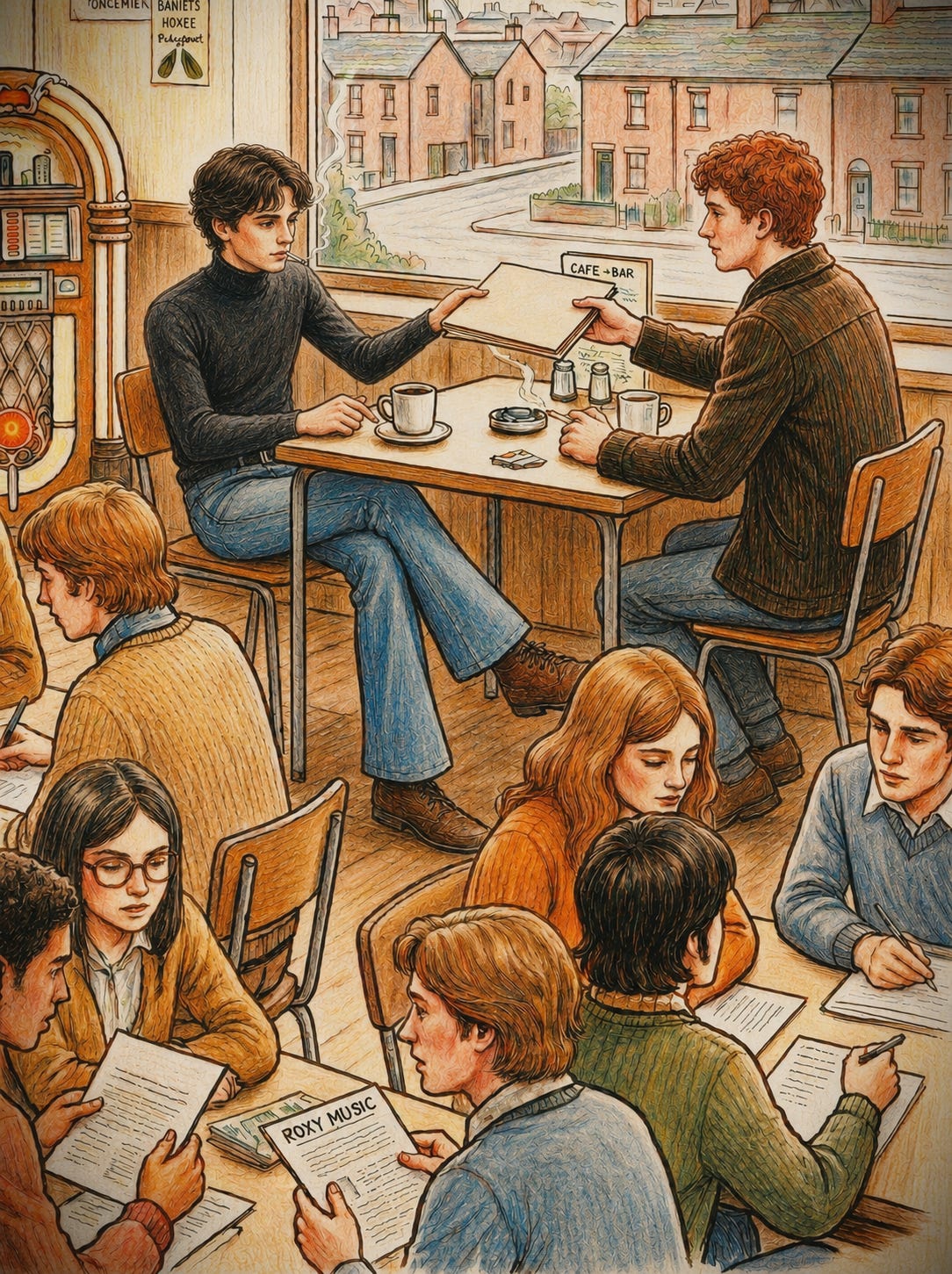
Having gone to her brother’s old school in search of information, Juliet “had braced herself for many things—but not a brother who turned out to be some kind of prodigy.” (5. “Among Strangers.”)
Jeremy Smith left school at fifteen.
Not because he dropped out.
He sat four A-levels.
In Britain in the mid-1970s, pupils intending to go to university normally took three A-levels at eighteen. Sitting four exams three years early required special permission from the school.
How was that possible?
The explanation goes back to one of the strangest educational experiments Britain ever tried.
In the early 1970s, Sutton-in-Ashfield Girls’ Grammar School disappeared. In its place came the Sutton Centre, an ultra-radical project so unusual that teachers and education officials travelled from across Britain just to see how it worked.
It barely resembled a traditional school. Pupils called teachers by their first names. Uniforms vanished. There were six coffee bars, a hair salon, and lessons that could last an entire morning instead of forty minutes.
Jerry picked up his coffee habit there, and the stylish haircut he wears in 1975 came from his time at the Sutton Centre.
Many parents thought it had stopped being a school altogether. Children skipped lessons. Discipline was loose. Academic standards fell. In Sutton, people argued endlessly over whether the reformed school was producing freer minds or simply wasting a generation.
For Jerry, though, the system worked perfectly. He learned at his own pace.
If he wanted to study Latin, he simply said, “I need Latin.”
At most schools, the answer would have been, “We don’t offer Latin.”
At Sutton, they found him a teacher—quite possibly someone from the old grammar school where Latin had once been compulsory.
Both sides benefited.
Jerry took everything the Sutton Centre could offer. The school had the kind of pupil every educational experiment dreams of producing. He became the face of the project—the boy shown to visiting delegations and featured in prospectuses.
Four A-levels at fifteen were remarkable.
The choice of subjects was even more revealing.
English Literature.
History.
French.
Latin.
Taken together, they pointed straight towards Oxford.
From there, Classics could lead to academia, diplomacy, even the intelligence services. History and French opened the door to the Foreign Office. Of all the possibilities, law looked the most obvious. It drew on everything he was already good at: precise English, close reading, historical thinking, and Latin, still woven into legal language and tradition.
There was one final step.
Some of the strongest sixth-form students also sat S-level examinations—the “S” standing for Scholarship. Far more demanding than A-levels, they could strengthen an Oxford application and, for pupils from low-income families, help secure grants or scholarships.
Jerry never sat them.
When the examinations were held, university was no longer part of his future.
At home, Oxford was not really a question of his future at all.
By then, Jerry was growing up in a single-parent family. His father, Oliver Smith, had been killed in a mining accident in 1970, when Jerry was eleven. His mother, Miranda, was pregnant at the time. Four months later, she gave birth to Julia (Juliet), and much of the day-to-day care of the baby fell to her son.
In later years, during one of their arguments, she would even accuse him of having “appropriated” her child.
His mother hardly noticed her son’s academic achievements. He was doing well at school and staying out of trouble, so everything was fine.
She was consumed by grief, worried about how to feed two children, and had quietly begun to drink. This led to arguments. But otherwise, they hardly spoke.
Then one evening he told her he intended to take his A-levels ahead of time.
She asked why and he answered.
The words were English, but they might as well have been a foreign language.
She had the feeling she was talking not to her son but to someone else.
He presented it all to her as a done deal—there was nothing to discuss.
She decided those liberal teachers at that experimental school had filled his head with nonsense.
So, for the first time, his mother went to Garden Lane—to the school—to “have a word” about her son.
She was shown in to see the headmaster, Stewart Wilson, who insisted she call him simply Stewart. He congratulated her on instilling a love of learning in Jerry—“you must have worked with him a lot,” he said—but she remained silent. She didn’t read books—except for the occasional paperback mystery—had no interest in history, knew only Merci and Bonjour in French, and as for Latin—what a ridiculous notion... She saw her son was their project—“they were betting on him”—and they had convinced him that “paths lay open before him,” that he was “above his background.” And what exactly was wrong with that background? They lived in the same mining town yet looked down on working-class people. And now her Jerry was doing the same.
If only she could have stopped him, forbidden it, talked him out of it. If only she could.
She began noticing things she had never paid much attention to before. It turned out he had money, and when she asked about it, his reply was, “I get paid for essays.” He didn’t work part-time jobs like the other guys—at a café, the post office, or a gas station. There was something about this strange source of income that she couldn’t quite put a name to. Nothing good. Real work meant the mines, the factory, or hauling freight. What he was doing wasn’t work.
And then he pulled it off: he passed four A-levels.
The experiment had its triumph.
The school celebrated him.
He made the local papers.
She hardly saw him. There were more exams to take, he had no time, he had to study.
She demanded an explanation: what was going on?
And then she heard the word: Oxford.
His mother shouted at him, “Come back down to earth! Look at where you are and look at Oxford.”
He refused to listen. He was determined to apply for a scholarship.
His mother tried to talk sense into him: what if the scholarship didn’t cover all the expenses? How would he live? How would he manage on his own when he was only fifteen? Besides, Oxford was for the wealthy and the children of aristocrats. He would never truly belong there. They would push him around. They would laugh at him.
To him, the matter was already settled. All that was required of her—the signature on the application.
For the first time since all this had begun, she could decide.
His mother made a proposal: if you’re so smart, go work at the mine—not at the coal face, but in the office; become a union leader and defend the interests of “your own people.” There, you’d have a steady wage and public respect—and most importantly, you’d stay with your family and be able to pay the bills.
He argued. For every word she spoke, he fired back two hundred. To her, he sounded unbearably arrogant. And when she started shouting, he answered in the filthiest language, peppered with words she didn’t recognize. Something called “ostracism”—what was that?
“Give me a dictionary so I can understand you!”
“To understand me, you’d need the *Britannica*.”
Her patience snapped. She threw him out of the house. Along with his things.
She expected him to return.
But she could no longer endure the version of him he had become.
In early summer 1975, he left home with £5.28.
That was the last time his mother saw him.
