



He looks like death warmed up.
John finally saw Jeremy Smith for himself.
John heard that name yesterday morning. And all day long, he had been talking about this stranger.
Yesterday was a complete disappointment.
John was late for the Magistrates’ Court. He had been instructed too late.
He arrived at St. Thomas’ Hospital. He was not allowed into the intensive care unit.
He only managed to speak with the consultant in charge. Although he had no right to examine the medical records, he learned enough from their “private conversation.”
Now John had to deal with the police guard—a dim-witted constable stationed at the ward entrance—and produce his practicing certificate to prove he wasn’t just some passerby. The constable mumbled something about prohibited items and a search but didn’t dare lay a hand on John.
The tiny single ward is bleak; the blinds are drawn.
Jeremy Smith lies on his back—sharp profile, hollow cheeks; in the dim light, he looks translucent. His left cheekbone is scraped, his wrists are bandaged, and an IV line runs to his left arm.
The head nurse said he was conscious.
John approaches the bed. The names Buchenwald and Auschwitz come to his mind.
“Who are you?” he hears a faint, hoarse voice ask.
Whether he hadn’t been asleep or John had woken him with his presence, he is now looking at him through half-lowered eyelashes.
“How should I put this, Mr. Smith? I am John Talbot-Cavendish, your future solicitor. After you...”
“I don’t need a solicitor,” Jeremy Smith says, closing his eyes.
“That’s unlikely,” John says, grabbing a chair—perhaps a bit too vigorously—and placing it by the head of the bed. “If you don’t mind,” he adds, sitting down. “Look, the doctors here wouldn’t approve, but I know you need this.” He pulls a pack of Benson & Hedges from his pocket and opens it. “Do you need help sitting up?”
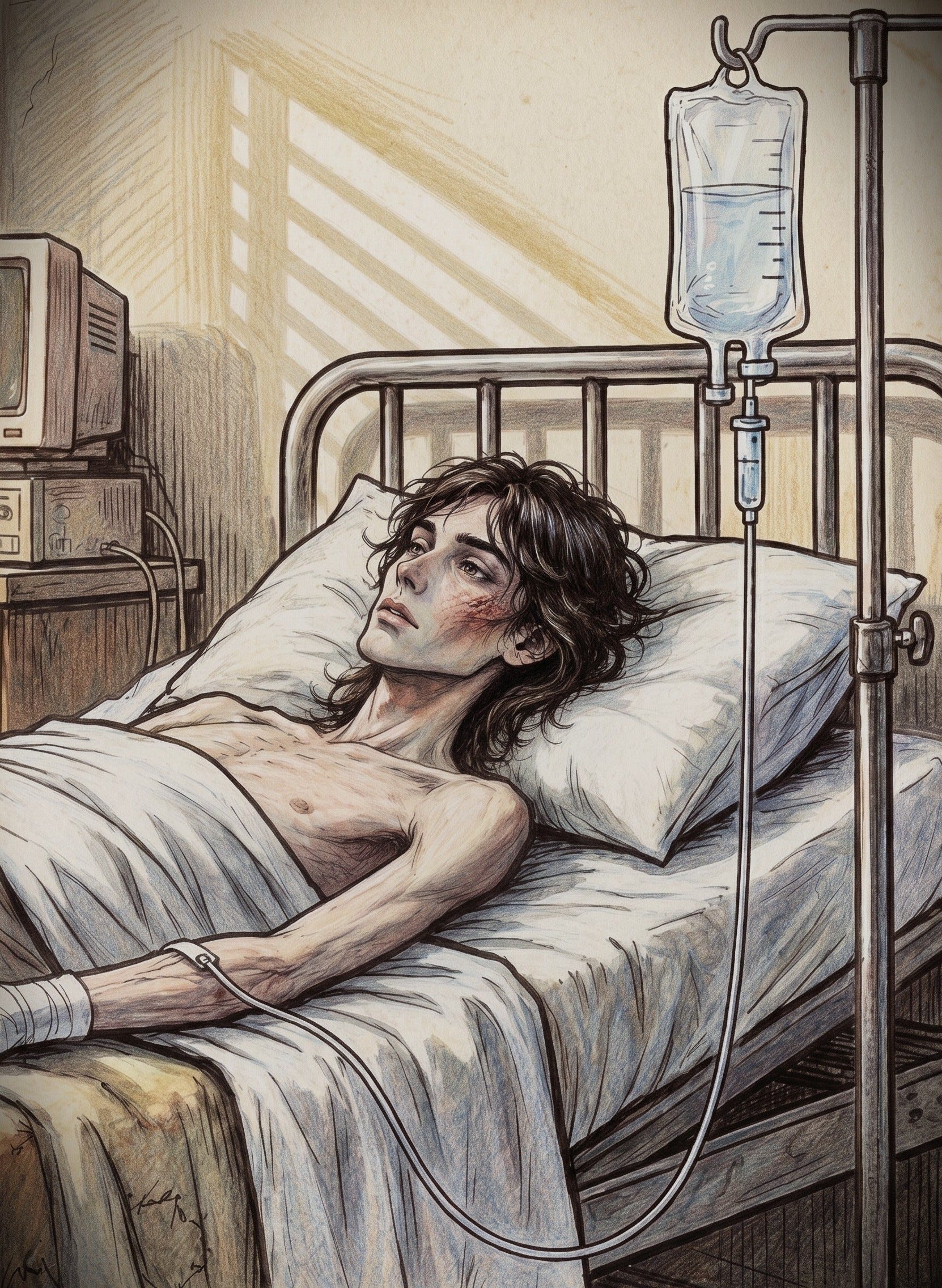
Apathy gives way to guarded attention. “I can manage.” Leaning on his right arm, he hauls himself into a more or less upright position and rests his head against the bed’s metal rail, breathing heavily.
John hands him a cigarette and lights it, then places the packet on the bed—right on the sheet; to avoid any unnecessary pleasantries, he adds, “I don’t smoke cigarettes myself. Cigars, usually.”
Jeremy Smith takes a drag, and a heavy, choking cough racks his body.
John waits for the fit to pass and for him to take another drag.
“Been a while since you smoked?”
“Since Friday morning. By the way, what day is it?”
“Tuesday.”
“Thank you.”
“It’s nothing...”
“Goodbye,” he interrupts again. “I’d ask you to leave and not return.”
“So you can finish what you started?” It’s a rhetorical question. “Do you know why you’re even able to talk to me right now? There’s glucose and salt in your IV drip. They won’t let you die—don’t even dream of it. If you refuse to eat on your own, they’ll force-feed you.”
He is smoking; the hand holding the cigarette is trembling. He prefers not to look at John.
“Five days without food. Did you really think no one would understand what you were trying to achieve? Mr. Smith, your plan was terrifyingly logical. You were alone, unprotected, and you decided to die so the case wouldn’t go to trial. There would simply be no defendant left to bring before the court. You pleaded “not guilty.” That is good. That is right. However, Mr. Smith, had you carried out that plan, people would have taken it as an admission. They would have said you took your own life out of guilt. You wouldn’t have spared your sister from being marked by it. You would only have buried the truth with yourself. Now, you have a chance to win the case.”
“Why?”
“I won’t pretend I don’t know what that question means.”
“There’s no need. Benson & Hedges.”
“He only learned of the situation on Sunday evening...”
“Why is he doing this?” for the umpteenth time he interrupts.
“I would rather you asked him yourself. But you can’t see each other. However, it seems to me that you are better informed about his motives than I am. I will tell you in general terms what I know: Elizabeth Landenberger will be a witness for the prosecution, and he, Alexander Landenberger, will be a witness for the defense,” John is nervous, and he knows that it is noticeable. “Mr. Landenberger has filed a petition for divorce.”
“Where is Juliet?”
“Mr. Landenberger asked me to let you know that your sister is doing well—as can be expected under the circumstances. Divorce is a long process. It’s not my field of expertise. I can keep you updated, but for now, it’s legal consultations on both sides. I mean, it’s not like they’re fighting over a two-bedroom flat. They’re civilized people.”
“She turns six on the 1st of March. Will they drag her into court?”
“I very much doubt it. It would be extraordinarily difficult for the prosecution to persuade the court to hear evidence from a child that young. If they try, I’ll oppose it.”
Jeremy Smith pulls a second cigarette from the packet. John ought to stop him, but he decides—not right now.
“Mr. Smith, as soon as you sign the Retainer, I’ll handle your bail. Since the magistrate denied it, I’ll apply to the High Court. I believe we can secure it within a week. In the meantime, I’ll do my best to have you transferred to the private wing. It’s difficult, but not impossible.”
John watches his reaction. Jeremy Smith is thinking. He hasn’t lit a second cigarette; he’s just holding it in his hand—as if he has forgotten about it.
“Two things should convince you. First, I will be your solicitor—not Mr. Landenberger, nor anyone else. I will act exclusively in your interests, Mr. Smith. There are fifteen people in my firm. They will all be working on your case. And the barrister I engage for you, along with all his assistants, will be *your* barrister. You will receive the best legal representation to be found in London. I guarantee it. Second, all the documents have been drafted to rule out any financial liabilities that could be claimed against you now or at any time in the future. Put simply, you owe nothing to anyone, regardless of the cost.”
Jeremy Smith seems to have lost interest in the conversation.
“Mr. Landenberger warned me you’d be quite skeptical,” John continues. “But I have to tell you—do what’s best for your sister. You need an acquittal.” John can’t read the expression on his face. “When you’re ready...”
“Give me the Retainer.”
At least he’s capable of making quick decisions.
John takes the papers out of his briefcase. He carefully removes the cigarette from Jeremy Smith’s fingers and places a Parker in his hand.
A ragged breath escapes him.
John pauses. “I wouldn’t want to encourage a hasty action...”
“You were convincing.”
“Mr. Smith... Ah, who am I to talk to you about life? You have a will of steel. Starving to death is so cruel to yourself. I mean, it takes a long time. And it’s painful...”
“Hunger is the sorriest way to die.” * He signs the Retainer, trying to keep his hand steady. “Sounds right for me.”
John lets the ink dry. “I hate Homer.”
Alex has warned John that Jeremy Smith might tell him to jog on—with a collection of f-words—but things had gone smoothly enough.
* “All deaths are detestable for wretched mortals, but hunger is the sorriest way to die and encounter fate.”
— Homer, The Odyssey, Book 12 (translated by Richmond Lattimore)
From Jeremy to Smith

“The Defense counsel’s closing argument was impressive, especially its conclusion...
