


“Never put off until tomorrow what you can do today,” the saying goes.
Jerry couldn’t afford to live that way.
He didn’t keep a list of things to do. He kept a mental list of things that could wait.
Every evening began with a question:
What can I leave until tomorrow?
Work always came first. Everything else had to fit around it.
Sometimes he had no job. Sometimes one. Sometimes two. At one point, even three.
Depending on how many jobs he had, he might be home by early evening—or not until nightfall. While juggling three jobs, he barely came home before midnight.
The problem wasn’t only that work consumed the day. In London, it also consumed hours of travel, and every new job meant a new route, a new schedule, another evening that no longer belonged to him.
On his way home, the first thing he would decide was whether he needed to stop at a shop—if he could get there before closing. In the 1970s, shops closed at 5:30 or 6:00 p.m. Corner shops stayed open later, but they were more expensive.
So, whenever he did make it to a grocery shop, Jerry would buy as much as he could carry.
In addition, his under-counter fridge was tiny, so shopping became an almost daily necessity—squeezed into a work break or the brief gap between his two jobs, always with the risk of running late.
Since smoking was still permitted inside shops, the checkout queue doubled as a smoke break for him.
By then, major supermarkets with the most affordable prices—like Sainsbury’s or Tesco—began putting up signs reading “Please Refrain from Smoking.” Jerry preferred to view these as suggestions rather than rules.
The moment he stepped across the flat’s threshold, he switched on the immersion heater. While the water was heating, Juliet needed feeding.
If Mrs. Jefferson had already given her supper, Jerry could skip his own meal altogether.
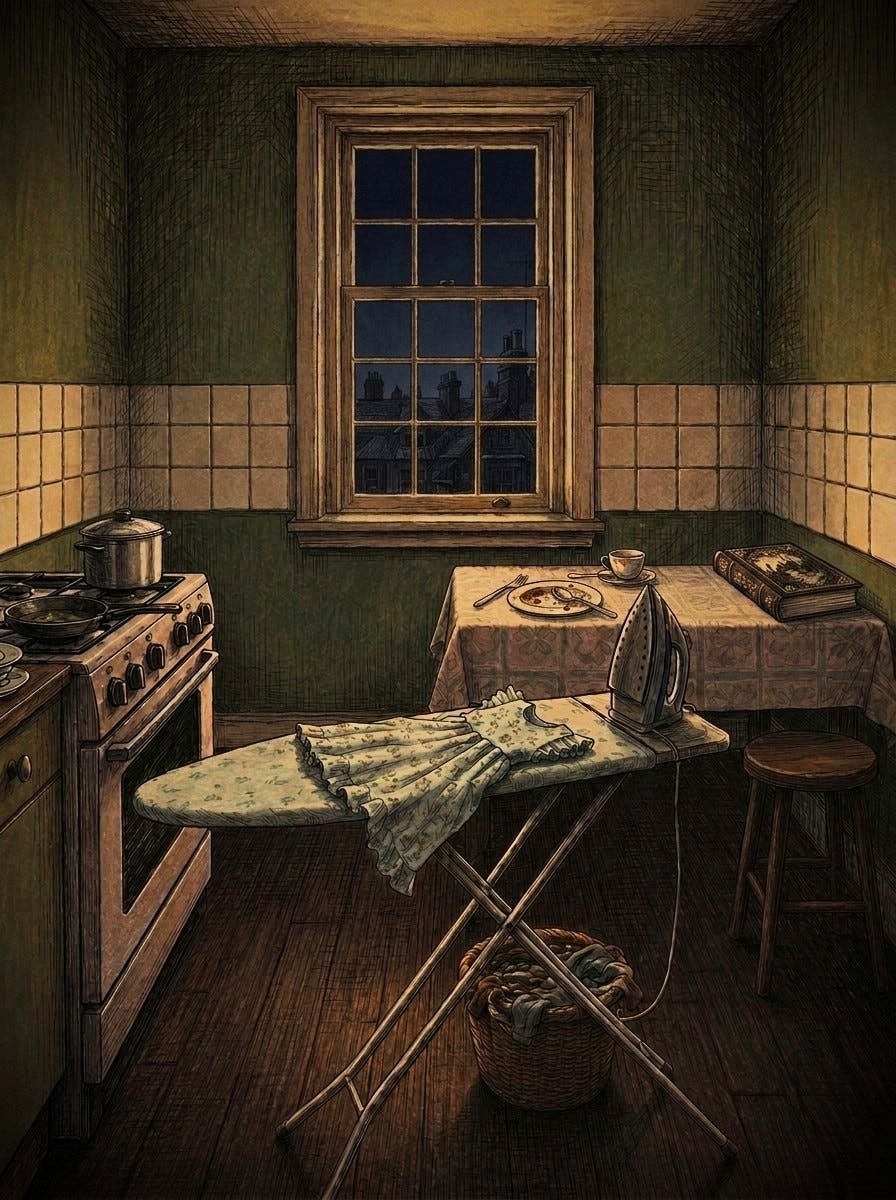
Otherwise, he had to cook. Jerry had only a gas cooker with an oven that lacked a thermostat and required manual ignition with a match.
While he cooked, Juliet sat at the kitchen table, swinging her legs and calling him over every few minutes. He wanted to tell her to go and play, but she hadn’t seen him all day, and even though he struggled to focus, he would talk to her or help her learn to read.
He didn’t own much cookware, so he had to wash up every day. Everything had to be washed by hand. Afterward, the dishes were set out to dry on a rack, so there was no need to wipe them down.
Fortunately, waste sorting hadn’t been invented yet.
The laundry was a thorny issue. The decision hinged on whether Juliet had anything to wear in the immediate future—not just tomorrow, since whatever she wore the next day needed time to both wash and dry. Boiling clothes indoors filled the flat with damp and ruined the fabric; for him, this meant hand-washing, hanging Juliet’s clothes on a line strung across the kitchen, and then ironing them.
He ironed while supper was on the stove and while Juliet sounded out another page of her reading book.
Although Jerry rarely scorched the clothes, he regularly burned the food.
Jerry owned one pair of jeans, a denim jacket, a couple of T-shirts and polo necks, and one warm jumper. Most of it never needed ironing. The exception came after washing. He ironed his few clothes to help them dry faster before he needed them again.
Mopping the floor was usually the first task to be postponed. He had to sweep, then mop it with a wet rag. It was a chore done only when he couldn’t put it off any longer—late at night and not very thoroughly.
Before bed, Juliet had to be washed and changed. A proper bath could wait until the weekend.
As for washing Jerry himself—that could be done quickly, maybe later, if there was any hot water left.
Juliet would cling to him whenever he tried to leave the room. One more story. One more minute. Sometimes she cried, just to make him stay a little longer and comfort her.
After that, whatever still needed doing could simply remain undone.
He didn’t smoke while cooking, so ash wouldn’t get into the food; he didn’t smoke while ironing, so ash wouldn’t get on the clothes; he didn’t smoke while washing Juliet, so ash wouldn’t get into the water. In the end, he didn’t have enough strength left for even one cigarette.
He just fell into bed.
Tomorrow morning, Jerry would need to wash, dress, and feed Juliet, leave some tea in a thermos and sandwiches under a napkin for her, and take her back to the neighbors.
While Juliet ate, he could have a cup of instant coffee and a quick smoke—there was no time for anything else. He’d wash his face—if he didn’t forget (he didn’t have to shave yet)—and run out the door.
In a few hours, the question would begin all over again:
What can I leave until tomorrow?
